Showing posts with label family. Show all posts

Saturday, June 27, 2020

Shorthand


ESCAPISM would have been welcome but my soon-to-be-81 mother decided to butt heads directly with an APC (armored personnel carrier) when I recently called her.

“Mga tangke de giyera (war tanks)” patrol the streets of Cebu City, reported my mother.

With relish, she added: So many of us here are “gahi’g ulo (hard-headed)”.

Her remark did not make me blink. My mother was born with steel plating bolting down that part of the brain that flips on the obedience switch.

She has mellowed, though, donning a mask and face shield when she leaves thrice a week for hemodialysis at a hospital as Cebu City weathers the changes of acronyms in the season of quarantine.

The mask forestalls her signature red lipstick but it sure sharpens those eagle eyes. When I pretended to nap after lunch, my mother, without putting down the novel she was reading, would say in the somnolent hour of siesta, “dili mag-gahi’g ulo (do not be hard-headed)”.

Guilt or self-preservation squeezed my eyes tighter, slowed my breath, and, without counting sheep, dropped me off to a nap. “Do not be gahi’g ulo” was fair warning to us youngsters as few things were more calamitous than grown-up meddling.

In our family’s linguistic shorthand, “da, gahi’g ulo” represented just dues for someone with a greater appetite for punishment than reward. When I fell inside a cement trough, sneaking to feed turtles raised for soup by my great grandparents, my yaya fished me out with an incantation of “da, gahi’g ulo” even though I fell in headfirst but, thanks to steel-plated genes inherited from my mother, only had to be washed free of mushed overripe bananas and turtle gunk.

Under special circumstances, the “hardheadedness” representing childhood’s cardinal sin acquired an opacity whenever the elders decided to sidestep messy explanations. Overhearing aunts whispering in shock over a teen pregnancy, I asked what caused the “disgrasya (accident)” and got immediately two answers: “she did not pray the rosary” and “gahi’g ulo”.

Sugbuanon language has nuances hiding meanings like the skirts of old women that inflate like balloons shielding their owners from a stranger’s immodest glimpse of flesh. Since I have sat inside an idling bus watching the same old women with the same voluminous skirts squat by the roadside to pee without the inconvenience of pulling down underwear, I imagine “gahi’g ulo,” as with the rest of the mother tongue, has more meanings than can be encompassed by a politician’s Pontius Pilate act of washing hands.

As my mother, the original maid of steel, pronounced: I hope they have enough tanks in reserve. “Gahia’g ulo ra ba gyud nato.” Take that extra “a” as fair warning.


Maid of steam (source of image: Shutterstock.com)


(mayettetabada.blogspot.com/ mayette.tabada@gmail.com/ 09173226131)


*First published in SunStar Cebu’s June 29, 2020 issue of the Sunday editorial-page column, “Matamata”


Saturday, March 21, 2020

Prepper


IT was past three in the morning. Friday the 13th. Wondered what woke me and read the phone screen: “Kumusta namo diha (how are you doing)?”

So S. and I reconnected the gap of some 30 years when I stayed put in the country and she married, divorced, remarried somewhere in Nevada. We met in one of my earliest jobs and clicked like sisters. I was definitely the “manang (older sister),” as unbending as a stick to the flash of sunbeam that S. was to everyone.

We bonded over, what else, the coronavirus. I mentioned the lockdown of Metro Manila and remembered the three eggs left in the fridge.

S. said her investments took a beating but that she has “cushions” laid away. Then she sent images of their stored drums of water treated every five years and canisters of food that will “stay fresh for 25 years”.

Survivalists, as portrayed in the 2012 National Geographic series, “Doomsday Preppers,” intend to survive a final holocaust, whether it be a “super volcano” eruption or pandemic. Yet, according to “The New Yorker” series, “Annals of Obsessions,” this American subculture is not just about stockpiling food or weapons.

Jason Charles of New York, when not on duty as a fireman, gets together with other families to learn how to prepare for the worst.

“The antisocialness that is developing in us is gonna be the danger for us,” says Charles. “We need to be social, we need to communicate… people need one another to survive.”

After going through my first phreatic eruption, first ashfall, and first lockdown, I think nothing is worse than the miasma of anxiety floating around as we freefall away from the ordinary and comforting.

Suddenly, respecting someone’s space has become “social distancing,” an infection control mechanism. “Quarantine,” “isolate,” “work remotely,” and “disinfect”—our buzz words move us inexorably to this moment, ever since we think in filter bubbles and connect on social media that’s often not.

In the age of anxiety, how can the preppers be a subculture? Starting “hard up” as an immigrant, S. cut her own hair, “never spent a dime” on fast food burger, did not own a credit card, and saved her “small salary.” S. never sent a balikbayan box to her family in the north of Cebu.

Lots she bought instead for her siblings. Relations live in her properties in Cebu City. Living in an “old small house” she bought with all her cash in 2009, when unpaid mortgages threw Americans to the streets, S. has not stopped being a Pinoy in the arid and freezing desert of Nevada.

Only a Pinoy knows what it means to have a roof over one’s head. And own this roof.

Thirty years ago, I nicknamed S. after a sunbeam for the joy she gives. My memory remains good.


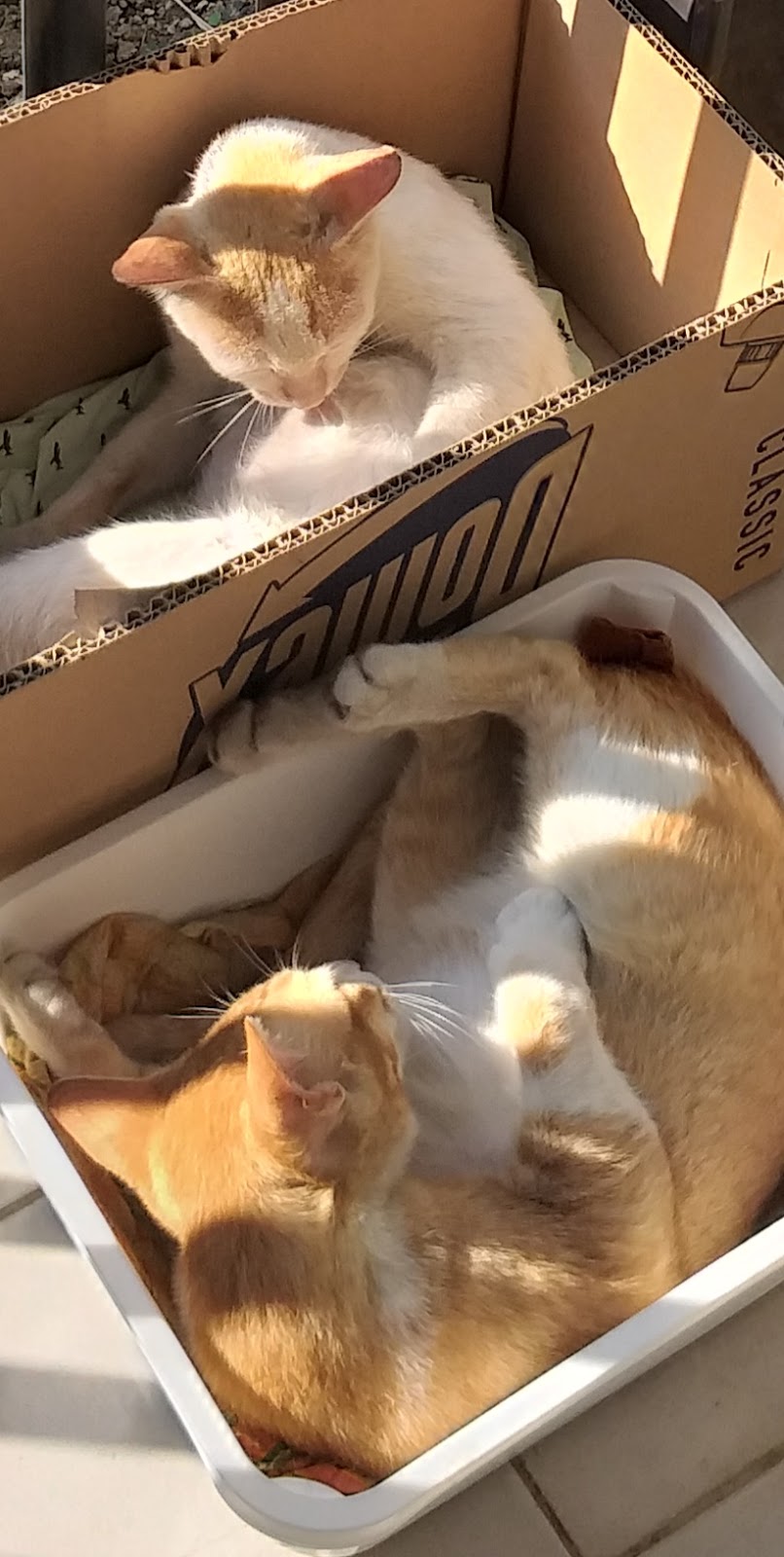
Sunning beauties. Kitkat and Tigr, Silang, 13 March 2019


(mayette.tabada@gmail.com/ 09173226131)

*First published in SunStar Cebu’s March 15, 2020 issue of the Sunday editorial-page column, “Matamata”

Saturday, October 19, 2019

Washi


SHE thought of herself as a washi housewife. Washi is the fancy paper favored by hobbyists decorating their journals in the YouTube videos she had been watching frequently.

In these scrapbooks, the washi is often just a strip holding down the corner of a cute cut-out. Sometimes, the hobbyist will stick a washi in a bare spot in the page, relieving it with the tape’s wash of color or delicate tracery.

In the Japanese pop culture of “kawaii,” washi tape, no matter how cute, stays at the periphery. Marginalia, she thought, applying it to herself.

If she didn’t live with him, she would be an absentee housewife. She knows she would rather read books than prepare meals and clean the place. Not that she minds the washing after meals. There is something inarguable and preordained about sluicing dirty dishes with water, soaping and rinsing, and drying them.

After she replaces the clean dishes in the racks, she takes a whiff of the plates’ sparkling expectancy, their readiness to be called again for the next meal, the subsequent dousing and purging.

When the cat gave birth last Tuesday, she counted it a blessing that he was gone the next day for a business trip. The cat was a stray that once brought her kittens and stayed. She gave birth to another litter but nested it elsewhere. She never saw that brood.

The thread of mewling she first heard while she was lost reading and trying to extricate herself from a writer arguing about sex, gender, and desire.

When she followed that keening to the box she had discarded after unpacking it of groceries, when she peered in and found the cat panting and the sleek, wet thing lying between her sopping hind legs, she panicked.

Her children were grown. Menopause was a thoughtless guest who promised to come but so far, had stayed away. Giving birth was hardly on her reading list, but she did what she thought the cat needed based on what she remembered from long ago: a bowl of water and food.

And an umbrella. It was near noon when the second thing slipped out and the third. When the cat finally emerged to drink the bowl dry, she took a break herself, feeling she had taken part in the cat and kittens’ passage.

The first evening she didn’t sleep well. After supper, many homeowners let their dogs out to run and pee. From the upstairs window, she watched the dogs bark and chase up and down their street, her fear coming and going with their baying.

At first light, she moved the box with the kittens to the kitchen where the grills prevented anything bigger than a cat from entering. The cat, clean and well-groomed again, re-entered the box. She stood outside, sleeplessness sluicing out all dreams of sparkling plates.


(mayette.tabada@gmail.com/ 09173226131)

*First published in SunStar Cebu’s October 20, 2019 issue of the Sunday editorial-page column, “Matamata”

Saturday, August 17, 2019

Summons


Hello, Death, old friend.

Will I recognize You when You come again? Fourteen years ago, as the family sat down in Papang’s hospital room for a silent supper, the flat line on the monitor announced itself like a hive of bees drawn to a riot of flowers.

In the electric distraction of extreme medical measures reviving his body, Papang slipped away with You and went home.

How else can I explain that in the same minute the Code Blue team was ramming a tube down the trachea to open an airway, neighbors spotted his figure pacing outside the house and his longtime companion saw a dark shadow going around the magnetic blue 1964 Volkswagen Beetle, older than I, his first child, by a year and arguably his first baby?

Death, You trickster.

Or were You hiding behind Papang’s feet, which splayed like the open wings of a resting moth, framing the imperturbable green of the flat line punctuating his 81 years?

A few nights ago, while washing dinner dishes in Silang, Cavite, I opened the door after hearing a strange meowing. Instead of one of the feral cats lounging around our place, an empty porch awaited. The brown moth was already resting against the ceiling when I went back to finish clearing the table.

In folklore, moths are harbingers of death, war, and disaster. The last two are anomalies but death, I disagree, is far from being a stranger. As a child waking up from afternoon siesta in the cavernous room of my great grandparents’ house, I cried shrilly to find myself alone and she would come running.

While dusty motes drifted in the shifting shafts of afternoon light, I dreamt of You, sniffed at the sweetly odorous mustiness of my great grandparents’ room across ours, where I imagined my great grandfather drowned in his sleep, where the pickled ham of my great grandmother’s amputated leg brooded, not far from the dirty kitchen where the turtles wept as they boiled.

Yet, whenever Mama entered the room, You stepped back. When she slipped me on her lap in the dentist’s chair, when I followed her voice and smile to emerge from motherhood’s anaesthetized dreams, You always deferred. Death is the terminus except where love is concerned.

The brown moth slipping in that night may have been You, up to Your usual confounding tricks. Except it wasn’t a moth, resting with open wings. Like hands folded in prayer, those wings marked the brown creature as a butterfly.

In my late grandmother’s garden, butterflies preened like orchids. The visitor that night was dun and modest but I listened and heard my mother’s labored breathing on the phone, the voices of my dead across the void: death is the terminus except where love is concerned.


(mayette.tabada@gmail.com/ 09173226131)


* First published in SunStar Cebu’s August 18, 2019 issue of the Sunday editorial-page column, “Matamata”

Saturday, December 16, 2017

Kitchen rules


SLOW conversations go with slow food.

We had Igorot friends visit for the weekend. For our last dinner, they prepared pinakbet and adobo, the Ilocano way.

It took a time to look for boneless bagoong from Pangasinan. And then more time was needed to slice the vegetables. The size of the pork cuts warranted another discussion. And the order of sautéing the garnishing.

Always, there seemed to be a Cebuano way and an Ilocano way. In a matter of speaking, there were significant differences in going about things.

And a spontaneous concurrence of what is good food.

Trying to combine Ilocano and Cebuano ways, we ate dinner at past 1 a.m. Somehow, all of us woke at 7 a.m. to whip up an omelet and then resume eating the pinakbet and adobo of undefined ethnicity.

Looking at the frothy mounds made by the whipped eggs, M. remembered that the omelet his mother made for him and his seven siblings was as thin and smooth as the film that floats to coat the surface when oil is poured onto water.

His mother warned all the children watching, round-eyed, as that omelet was sliced and distributed around the table that there was no need to ask for more.

Mealtimes where “more” did not exist taught M. and his siblings that rice was not a staple but a strategy. He said he buried his viand in a mound of rice. After everyone else had eaten, he dug out and ate his hoard.

He felt full, whether from consuming his share or being consumed by his sibling’s envy, he could not say.

R. said having too many mouths was also a challenge for researchers in remote areas. He and his fellows once bought a chicken from a farmer.

The native fowl was lean and compact, virtues for a boxer but not for the meal prospects of ten hungry youths. D. volunteered to cook the chicken.

Sliced and spiced, the chicken adobo ended up as the dish for no one except D. When R. complained that the dish too spicy, D. explained that pepper is the secret in cooking. Why, he now had an entire chicken to finish!

Sharing a meal reminds us that we have more than appetites in common. M.’s drunk father insulted his neighbors. Walking home, M.’s father was set upon and nearly beaten dead by the neighbor and his sons.

Months later, these neighbors visited M.’s family to apologize. M. recalled that when it was their turn to visit, these neighbors would cook and eat breakfast even when M and the family were still in bed. Isn’t this tolerated because it’s all in the family?

M. asked his neighbors: When one’s father becomes an ugly drunk, do you look the other way or knock out all of his ugly teeth?

To this day, M. and his neighbors still visit each other’s home on the other side of the mountain.


(mayette.tabada@gmail.com/ 09173226131)


*First published in SunStar Cebu’s December 17, 2017 issue of the Sunday editorial-page column, “Matamata”

Saturday, January 09, 2016

Thank you, 2015


Our new school calendar, which starts the first semester in August and concludes this in December, posed one of the toughest hurdles last year.

I realized this when Christmas approached. Unlike previous years when the academic pace also winded down to give way to rehearsals for silly, giddy Christmas party presentations, our college yanked up the pressure with final exams and all the refined torture of “hell week”.

The worst for me was deciding to fail a student.

Underneath all that wrapping, Christmas teaches compassion. My dictionary defines “compassion” as the “desire to help” someone in suffering.

I imagined myself as a young person checking online and finding out, a few days short of Christmas, that one has to repeat a course or know with certainty that one will not be graduating with the rest of the batch. How will a setback like this help?

In a room in Tagbilaran, where I finished the final checking and grading, I remembered my late father’s philosophy. A physician-surgeon who trained post-graduate interns, he believed that every student’s failure was also shared by his or her teachers.

He viewed failure, though, as going beyond a failing grade and repeating a course. Whenever he was asked by the registrar to respond to complaints from students that had to repeat a course, with all the attendant expense, my father said he owed it to future patients that his students didn’t become doctors because my father passed them out of pity.

When a doctor fails, his patients are never around to complain, he said.

This year, I also learned about teaching—work that threatens to become but never really lapses into being routine after all these years—from my students. One of them is K., who could infuse a variety of emotions in intoning “Sayang ang learning,” his stock response whenever I gave his class another assignment.

When a young person complains about the excess of opportunities for learning, teachers like me are prepared for the usual fusillade of sarcasm, followed by creative displays of mediocrity.

I think K. found sarcasm too predictable, preferring the literal and straightforward. Since I believe a sure way to learn writing is through rewriting, I gave students opportunities to rewrite articles and earn a better grade with every rewriting, provided the copy improved rather than deteriorated.

K. wrote a review about a café serving macaroni and cheese that made me write with red pen on his first draft: I think there’s too much cheese here. He rewrote and rewrote his copy until I felt a gooey mass was actually stuck irretrievably down my gullet.

So, thanks to K. and his peers, I’ve relearned to reread not just language and ideas but the young. Just when I think age and experience give a vantage point, the young show there are more insights to be drawn from changing vantage points.

From the year that was, here are other things I am grateful for:

Family. I know myself better when I am with people who don’t draw back in letting me know how much I irritate them and why they’ll still be around, despite the first reason.

Families. Bloodlines are not the only ties that bind. Work creates families that deserve the same commitment. For a writer, sharing history with a community focuses the work and recharges the passion.

Faith. Each year brings the gift of remembering and moving forward.

(mayette.tabada@gmail.com/ mayettetabada.blogspot.com/ 09173226131)

*First published in Sun.Star Cebu’s January 3, 2016 issue of the Sunday editorial-page column, “Matamata”

Saturday, October 17, 2015

Infinite


THEY don’t make women like Lola anymore.

My maternal grandmother passed away recently. She was 97. These past five nights have been surreal. Except for the fact that my grandmother lies inside a white coffin and the smell of flowers is heavy and cloying, her wake could have been one of her parties.

Since I was a child, I can count the number of times I saw my lola eat during family reunions with all the fingers of one hand. She greeted arrivals with a request that was also a command: “Kaon na (do eat).”

She would repeat the phrase an hour later when she passed us again. Even though we were thoroughly stuffed, our lips still shiny from “bam-i,” “dugo-dugo” and lechon, Lola would urge us again, “Kaon na”.

Moving from room to room, she made sure platters were refilled, the dessert taken out of the fridge just as everybody was ready to tackle it. As the years stooped her profile, children and grandchildren pressed her to slow down or took over the organizing.

Yet, even if she had a plate where she pushed around the food, her eyes never tired of scanning the plates of those around her. In making the family her life’s work, Lola turned to food as her secret fixative: a family that eats together shares more than the same gluttonies.

The privileges of being the oldest batch of grandchildren were manifold. Lost forever, too, I realized whenever I greeted her these past nights. The ivory dress they dressed her in reminds me of the hue of her unforgettable meringue, crunchy on the outside, chewy at the core.

Ivory with flecks of gold was her favorite walnut-sprinkled icing for the lightest, spongiest chiffon cakes created. Ordinarily gluttons for play, my cousins and I competed to assist her baking for the singular privilege of later licking off the icing from the spatula or egg beater.

So we heard her on a few occasions testily tell no one in particular that she was tired of cooking, even on her birthdays. Either due to my youth or haste to reach and lick that last unreachable spot of icing, I did not realize the terrible possibilities if my grandmother had acted on a moment’s weakness.

The complacency of youth assumes the inexhaustibility and constancy of love. Children assume families run on some infallible power that patches and sorts conflicts like laundry. The rituals of keeping together require deprivations and sacrifices made savory by a family heirloom recipe, a harvest of memories.

On the last night of the wake, my aunt, 92, asked me for the cause of Lola’s death. Without waiting for a reply, my aunt recalled how my grandparents met in Zamboanga.

A doctor, Lolo was infatuated with a woman in Cebu City who frequented cockfights. My great grandfather arranged for Lolo’s transfer to Zamboanga, where he met my grandmother, a nursing student.

Though nearly blind, my aunt remains our family’s storyteller. In her retelling, I saw again Lola teaching my cousins and I how to whip the eggs in the same direction. Repetitive, tiring, and monotonous, correct egg-beating may have been the secret behind Lola’s meringue and chiffon cake.

Though there is no shadow of that Zamboanga student in the ivory-dressed figure in the coffin, I am grateful, Avelina C. Solon. For sacrifice without stint, for love without end.


(mayette.tabada@gmail.com/ mayettetabada.blogspot.com/ 09173226131)

*First published in Sun.Star Cebu’s October 18, 2015 issue of the Sunday editorial-page column, “Matamata”


Saturday, May 10, 2014

“Halok”


“HALOK (kiss)” on Fridays, the feast day, usually entails lining up behind many visitors of the replica of the original image of the Sto. Niño at the Basilica.

“Kissing the image” is not the best translation for the practice, pursued by different people for different reasons in different ways.

The image is encased in glass, stone and wood. Unlike other life-sized icons whose paint is worn away by years of penitent rubbing to reveal dark, stained wood, the Holy Infant image is still mint, bestowing on visitors a smile lurking in its eyes and half-tilted mouth.

Only the marble tiles that have sunk to the ground in front of the image tell tales about the feet shuffling over the years.

To hear oldtimers describe it, the practice of “kissing” the image used to be so convoluted and drawn-out, the visitors spilled outside of the Basilica and snaked round the block. The “halok” was in itself a pilgrimage, with visitors from outside Cebu spending a day or more to keep their “panaad (vow)”.

Today, guards keep the line moving by asking visitors to abbreviate their “halok” (often pronounced as “hawk” in keeping with the city practice of shortening a word to ease pronunciation). The longer personal prayers can be uttered at the sides of the shrine, whose glass panels allow visitors a glimpse of the left and right profiles of the image.

In the queue is a mixture of locals and tourists. Clothes and conversation are not the only way to tell apart the two groups. Tourists are attached to their cameras and smartphones. Their casual attire says that the “halok” is just another stopover, perhaps between getting dried mango in Guadalupe and dried fish in Taboan and cooling in the beaches in Mactan.

The young man in front of me took several selfies during the 15-minute queue last Friday. I did not want to spoil his selfies or end up on his Facebook wall so whenever his arm raised the smartphone, I ducked away, weaving side to side like an old boxer trying to stay in the game.

My “drunken master” routine amused someone. When I ducked, I felt someone touch my behind. Turning, I saw a man long past middle age. In the airless corridor, he looked even more wilted than my collar.

But when the touch was repeated, I could no longer dismiss the “accident”. Quickly turning around, I caught my tapper red-handed: a small girl in a shiny pink dress that looked new except that it was halfway down her waist.

Either she was a late child or a granddaughter of the couple behind me. The girl just can’t stand still, her grandmother apologized.

I forgave this tiny creature for mistaking my substantial behind for one of the balloons vendors carry around the Basilica. Balloons, popcorn, snapshots by a roving photographer: when I was a girl, a day in the Basilica meant all these three.

Today’s kids can choose fatter, nicer balloons that resemble popular cartoon characters. I’m glad the practice of releasing balloons to bring petitions skyward has lost favor. If I had a Dora the Explorer balloon that escaped to the sky and later, ended in the sea, it would be the end of the world for me, as it would be for the sea creatures unable to dive back or eat after swallowing the deflated balloon.

The salty yellow popcorn in its cellophane bag is gone. The frenzy of finger-licking and greasy stains left on new clothes were reasons why wise parents always posed their children before photographers as soon as they got to the Basilica, not later.

Yes, in the age of digital cameras, the “maniniyot” survives. Roaming the Pilgrim Center, these men and their cameras may be vintage curiosities to the selfie generation. Watching a photographer coax a human whirlwind into standing still and flashing several missing teeth that will end in a family album (another curio), I think the “maniniyot” documents down the ages what sets apart the devotion to the Sto. Niño: its attraction for children and families.

When it was nearly our turn before the icon, the little girl was cradled by her grandfather while her grandmother took from her bag two hand towels for wiping the glass panel. These will be shared with folks back home, a form of “extended” kiss.

During their first visit to the shrine, the grandmother remembered that she had carried the infant: “Now, she’s walking.”

Some kisses do linger.


(mayette.tabada@gmail.com/ mayettetabada.blogspot.com/ 09173226131)

* First published in Sun.Star Cebu’s May 11, 2014 issue of the Sunday editorial-page column, “Matamata”

Saturday, March 03, 2012

“Matamata”: Picking bones*

CAN you eat and sleep with human bones?

It was with a jolt that I learned from a colleague that the room where we ate lunch and rested also stored a skeleton.

Someone donated the remains for students to study the human body. When there was a hitch in constructing the model, the bones were moved to the darkroom.

The box containing the bones resurfaced to our attention when the room was renovated. While our group talked about stopping wood rot and condemning power outlets, the box containing what used to be a person reposed not two feet away— not quite yet in a state of eternal rest due to an earthly conflict of theory and practice.

Who was he? Or she?

In the confusion of awareness, ascertaining the gender seemed as important as determining what should be done for what was in the box. This after all was someone who moved around in this world before moving on.

What if the family of cats that slinked in and out of our rooms had helped themselves to the box when the waste basket pickings were lean, say, over a long weekend? After all this time, we might not even have enough to honor the dead or to construct a model for artists to sketch.

Yet not one of us approached and opened the box, lying on top of old term papers.

It’s more than superstition that makes us uneasy around bones. When my great grandfather passed away, the clan placed him to the right of my great grandmother’s remains. I was told couples should never be separated, even by death.

Behind the expansive slab of stone where they reposed, workmen constructed smaller square shelves.

This became a favorite place for us children to hide behind in our games. It was a two-day wonder for me when they transferred other bones in the cabinets I thought were made to hold unused flower vases or candle holders. When you were buried for a long time, how could people tell this pile of dust was you, not someone else?

Recently, over coffee, my friend E. recounted how she and her cousin searched in cemeteries for ancestors that migrated from Germany to Australia. They had only a few handed-down stories of the mother and older siblings of their patriarch. If family history is a many-roomed complex, E. and her cousin never played near these locked, boarded-up rooms of their clan’s past. How can you find the past without memory as your guide?

With the assistance of a local historical foundation, E. and her cousin gained access to a database, which listed all the deceased who shared the family name as their patriarch. Their search eventually ended with them, reunited, walking around cemetery plots, whose coordinates were specified in the database.

In the National Library of Australia, amateurs piecing together bits of their family history can help themselves to all kinds of records and indexes in paper, microform and electronic formats: births, deaths and marriages, immigration and shipping, naturalization, parish registers, censuses and, yes, cemetery transcripts.

In this country, knowing the past is racing against the inevitable: memories decaying, paper decaying, lives ending. Bones cast a superstitious pall but are poor storytellers. While trying to trace how my family’s history began, I realized I did not even know where my great great grandparents were buried.

I called my uncle, who, at 87, can vividly trace our ancestors’ route from the old Catholic cemetery to the bone chambers in a private cemetery. The very same cabinets I left my offering of candle stumps, wilting flowers and balls of wax. Whose marble slab released the day’s heat to our flushed cheeks, pressed against it while hiding and giggling those long endless afternoons when the young played beyond the reach of ancient, mute bones.


(mayette.tabada@gmail.com/ mayettetabada.blogspot.com/ 09173226131)


*First published in Sun.Star Cebu’s Mar. 4, 2012 issue of the “Matamata” Sunday column

Finding Lonso and Amoros

PERSONAL history is the business of raising phantoms.

In this country, memory—even of the intimate—is at the mercy of termites, fire, war, even lack of a permanent address.

Even worse, since it does not only leave no trace but creates no tracts, is apathy.

I felt this gossamer flutter when I researched recently about my great great grandfather Juan “Hantoy” Solon. He is the stranger preserved in a sepia photograph stored by my elders.

His wife Jacinta “Intang” Palacio Solon is different. In 1998, I wrote a newspaper article about my great great grandmother and the hojaldres named after her. My source was my aunt, Juanita “Niting” Solon Villarosa.

I was often at Tita Niting’s home to read magazines. She had a hobby of cutting out recipes. I was indifferent to cooking but liked listening to her stories of the old days. She recalled how her grandmother created a dainty that became a favorite pre-war “pasalubong,” delivered by horse-drawn “tartanilya” from the Calle Zulueta home to the pier, where their buyers awaited.

After Intang died, her husband Hantoy and son, Filomeno “Menoy,” continued Hojaldres de Jacinta Palacio de Solon, later known as Hojaldres de Cebu.

In 1998, I was fascinated with Intang. Aside from being a wife and mother, she was an entrepreneur at a time when to be female was to fulfill a manifest destiny that rarely extended beyond home and church. Yet, she died young. As her figure retreated to the shadows, my excursion to the past ended.

Recently, I revisited the Zulueta period to seek more clarity about another phantom: Intang’s widower Hantoy.

My guide is my uncle, Jesus “Etot” Francisco Solon, grandson of Intang and Hantoy. At 87, he can not only outwalk many of his peers, his memories are more lucid and detailed than the records and memorabilia he stored over the years.

What he regrets deeply, though, is losing the notebook where he jotted down the “balak” (poems) Hantoy dictated when he was bedridden. According to a 2005 Philippine Graphic article written by Fr. Miguel A. Bernad, one of their pre-war student boarders, Hantoy spoke in Spanish but wrote poems in Visayan.

Rainy days inspired Hantoy. Dressed in a cap, sweater and loose balloon trousers tucked into socks—Fr. Bernad nicknamed him as “The Baseball Player”—Hantoy penned poetry that was published in the local dailies under the pen name “Lonso,” a play on his family name.

When the Americans bombed Cebu, the family evacuated to Kotkot, Liloan. In the chaos, Tito Etot lost the notebook containing many of the Lonso “balak”. Only one endures, a 1928 poem entitled “Alang sa Mga Inday,” republished in the Cebuano Studies Center anthology, “Cebuano Poetry (Sugbuanong Balak)”.

After I read Lonso’s original Cebuano and the English translation by Simeon Dumdum, Jr., Tito Etot then turned the anthology’s pages and showed me a “balak” penned by another Solon relative. Reading the title and first stanzas struck a chord in me.

According to “Cebuano Poetry,” Hermenegildo Solon wrote “Garbosong Bukid (Proud Mountain)” in 1907.

On May 5, 2009, the noontime heat was making me drowsy in my note-taking at the Badian Municipal Hall. My husband and I were interviewing local sources for the Badian town history commissioned by the Cebu Provincial Government. Garrulous old-timer Venancio N. Español banished all thoughts of sleep with his anecdotes.

Here is my retelling in the Badian town history of the Badian poet known as Amoros: “(Hermenegildo) Solon was the secretary of Badian Mayor Tranquilino Agravante (1906-1908) when the former incurred the ire of Tankinoy, the nickname given to the mayor. Solon was imprisoned indefinitely, an experience that fueled his writing of ‘Garbosong Bukid’. Although it has been written that respect and recognition eluded Solon in his hometowns of Dumanjug and Badian, Badian native Venancio N. Español recalled that ‘Garbosong Bukid’ was used as the electoral campaign theme of Flaviano Taboada, Badian’s mayor of 1915-1917.”

Amoros composed the music, too, that made his balak into a popular song of protest, using analogies of nature to caution against arrogance and the impermanence of power.

To Tito Etot, Amoros was the relative who regularly visited the Calle Zulueta home to read newspapers in Spanish. The room he stayed in became known as Cuarto ni Amoros.

Nothing more was known about Lonso and Amoros until that recent afternoon when our resurrection of family phantoms yielded nuggets we could read and savor, despite the passage of more than a hundred years.


(mayette.tabada@gmail.com/ mayettetabada.blogspot.com/ 09173226131)


*First published in Sun.Star Cebu’s Feb. 26, 2012 issue of the “Matamata” Sunday column

Saturday, May 07, 2011

Holy mysteries

GOOD Friday in Dumaguete is still slow enough to savor a procession.

Our family stood at a corner of Perdices St., waiting for the Santo Entiero procession to start.

The mass after 3 p.m.—the time Jesus expired on the cross—found the St. Catherine of Alexandria Cathedral, also known as the Dumaguete Cathedral, full of people and, this being Dumaguete, mopeds and motorbikes.

The 17th-century landmark is reportedly the oldest stone church in Negros. Our group of four found a spot on the cathedral grounds, but the children and a far-from-penitent sightseeing mood made it difficult to concentrate on the service.

Filipino piety is a mix of contradictions. We bring our small ones to hear mass, and then bribe them away with candies or any sweet sop, bought outside the church, so they will not run up and down the aisles or cry the place down to kingdom come.

Perhaps to leave in peace mothers and the older siblings to pray and sweat inside the church, fathers are sent out to divert tots for the mass duration. It seems to be a welcome release, with the tiny tornados getting stickier and wound up by the minute and their relaxed paternal guards, indulging with a cigarette or the sight of other mothers and mothers-to-be.

What would other witnesses say?

Towering beside the cathedral is the 18th-century belfry, said to be the oldest bell tower in the Visayas.

Even the uninitiated can guess the purpose of this conical structure, lichened, solid and impregnable except for the “eyes” near the pinnacle, the lower ones for detecting the pirates that once launched their attacks from the sea and the upper ones, suspending the bells that sounded the alert.

The old belfry is now relegated to the duty of summoning the faithful to mass. I cannot recall hearing the bells toll. Many churches replay recorded chimes, the religious version of karaoke, a charming tinkle that utterly fails to reverberate in the internal chambers where faith, or doubt, resides.

Still, because it has sightseers like me, forever looking up in awe at its pinnacle, the old belfry is not so diminished from its early days, when it was the phallic symbol of vigilance and resistance, steady consort of Mother Church. Along the southern coast of Cebu, some watchtowers have fallen into forgetting or the worse ignominy of being sold and re-sold, along with beachside property and a priceless view of eternity.

This Good Friday procession, like others I’ve witnessed or participated in, took time to begin.

Circling the blocks along Perdices and Real Sts., this was also the quietest by far. The crowds spilling out of Rizal Park and munching a nearby fast food joint’s trademark crispy chicken skin was muted, guilt apparently being better than abstinence at dampening premature fervor.

Even the hawkers of bottled water and the cartoon-character balloons enticed without, well, hawking. Some of them were quite the sidewalk mime artists, having many speechless ways of waving a sweating bottle at a prospect.

When the procession finally snaked before us, we were unable to identify all the Marys, or the women figuring in the replaying of the Holy Burial. Since the life-sized images are owned and preserved by families, it is understandable that these depict not the actual bloody mess of the flagellation and crucifixion but a gilded version of Christianity Triumphant, post-oppression.

Lights, flowers and sumptuous gowns mark the Filipino’s celebration of Mary and the other women. Even in the midst of embracing a torn corpse or holding a cloth imprinted with the bloodied visage, these biblical females radiate star power. Perhaps it is easier to swallow the ashes of our mortality with a liberal sprinkling of drama and pageantry.

The figure I awaited, though, was Joseph. In this Marian-fixated country, Joseph has his following but not enough devotion or scholarship to peel away the mystique. Who was the man who crucially stepped into Jesus’ life? Who taught his craft to the child? But who is not seen at all when He was crucified?

Heading the Santo Entiero procession in Dumaguete was St. Joseph. Confronted with the timeless challenge to “dress up” a male in the company of female flamboyance, someone covered Joseph’s halo with chasing Christmas lights.

Looking more like a disco king, this Joseph trundled past, another enigma for deciphering.


(mayette.tabada@gmail.com/ mayettetabada.blogspot.com/ 09173226131)

*First published in Sun.Star Cebu’s May 8, 2011 issue of the “Matamata” Sunday column

Saturday, March 26, 2011

The baby blogger

I’M a fan of mall events, specially the unplanned ones.

Recently, while accompanying the husband and teenage son to check out gadgets, we turned a corner and almost bumped into celebrities.

My foot-dragging made me swerve in time and avoid a collision with Rei’s baby bump. Rei is the first of my former students I saw get married on Facebook.

That evening, Rei and Baby Bump (BB) were accompanied by The Baby Blogger. “Insoy,” I babbled. “I’m a fan of your baby blog.”

The bleary-eyed fellow eclipsed by Rei’s beatific smile and BB is known better to readers of news and the Sunday Light section of this paper as the editor, Lorenzo P. Niñal.

Every Tuesday, in the op-ed section, Insoy can be entirely blamed for the “Insoymada” column.

A habit of reading Insoy has made my Tuesdays wry, dry and off-the-wall. Yet I’ve noted that, for the past months—nine months, to be exact—the driest Insoymada to sink and break your teeth on in the land shifted tone, actually becoming gushing, warmer, generous, tasting almost suspiciously like breast milk, or what the milk of human compassion would taste if it came direct from the pair attached to a former seminarian who skedaddled when he couldn’t swallow transubstantiation, morphing into a writer, poet, agitator for Bisrock, save-the-children advocate and recently, father, husband and this paper’s unofficial savant on infanticipating.

Looking at The Baby Blogger in the flesh, it was hard to believe it took this guy an extraordinarily long time to find his groove. He looked so terrible—bluish half-circles under the genuinely bottomless holes that only fatherhood can bring, nest of a hair cut circa-BBB (Before Baby Bump)—I now can accept that this guy is really having the nesting instinct bad, that he wasn’t just being cocky and stealing the limelight from Rei when he wrote in response to a reader of his December 2010 column, “Tastes like Baby Spirit,” that “wala pa mi nagpa-ultrasound.”

Aww: how many do you know break the barrier separating Me from We?

When his blog, insoymada.com, generated a flurry of likes on Facebook, I realized how it takes the Other Better Half to celebrate March as the Month of Women.

We’ve become so desensitized by the statistics on domestic violence and abandonment and the cases of and-they-lived-unhappily-ever-after that we miss the fellows who make it possible for us to enjoy being mothers, wives, professionals.

In 2005, the Province of Aurora in northern Luzon passed a reproductive health code that, among others, pushes for and recognizes the contributions of men in the household, from planning families with their partners to taking care of the kids day by day.

According to the Mar. 7, 2011 article of the Philippine Daily Inquirer, the men and women of Aurora walk tall for having the lowest annual population growth rate of 1.07 percent, first recorded in 2007. A provincial health officer observed that fatherhood should not just mean working away from home but also being present for loved ones: cooking for and bathing the kids, bringing them to school, minding baby so the mother can recover after birth.

Being contrary and skewered, Insoy keeps a column and blog that attest to how boundless, creative and mysterious fatherhood can be: inducting BB to the hall of music but substituting rock and heavy metal for lullabies whose lilting melodies mask violent lyrics (“Smells like baby spirit”); discovering during Mother’s Class medical proof that men’s breast do have some use (“Breastmilk is best for fathers, too”); and giving up smoking, drinking and bad literature for the sake of future generations (okay, so he still has to write that column).

As he’s written ad nauseam, Insoy says he’s not a perfect human but that doesn’t stop him from trying to be a good husband and father.

Okay lang. We recognize a beautiful soul (even when they’re ugly and infanticipating).


(mayette.tabada@gmail.com/ mayettetabada.blogspot.com/ 09173226131)

Saturday, December 18, 2010

Eat, memory*

MY niece, Aurora, is a force of nature. We waited a long time for her but when she finally came, you could say there was a lot of surprise on both sides.

Just before Rory turned six months old, my sister’s family came home so our youngest member could meet her Cebuano side.

Approaching the airport, our generally nearsighted horde already spotted the wee creature propped against my sister’s belly.

Look at those eyes: hungry and angry. She’s one of us, another appetite, we chorused and closed in.

A few minutes into our home-cooked “salu-salo (meal),” we were horrified, dismayed, shaken to the core. Rory could not take any solid until she was back in Australia. This would be a few weeks later, when she turned exactly six months old.

I don’t know what medical mumbo-jumbo a New South Wales general practitioner spooned into my sister, but she would not budge beyond giving a few drops of boiled mineral water to the wee one we planned to induct at that holiest of holy, the dining table.

Naturally, we stooped at nothing. Bribery: “Why don’t we take care of Rory while you address this 24-egg yolk leche flan?” Watery humor: “It’s not as if we expect a baby (sniff) to gnaw the whole lechon (snort)”. Machiavellian logic: “Don’t tell the doctor. Don’t see him so you won’t lie. Get rid of that quack”. Political correctness: “That culturally insensitive ignoramus does not know what Philippine law says about infant abuse during reunions. How can we culturally indoctrinate someone whose taste buds know only your milk?”

We only desisted from all-out aggression when my sister finally cried while nursing Rory. My poor sister’s fat tears plopped on that innocent, giving probably her first taste of the salty—still, a very pale imitation of the 7 levels of nirvana attainable by way of “pusit (dried squid)” and “danggit (dried fish)”.

By the time they flew back, we conceded but remained hopeful. Rory stuck to her pure diet of mother’s milk, but her eyes followed our hand-to-mouth existence and her pudgy fingers would snap off an imaginary crispy “panit (lechon skin)” to plop this inside her tiny mouth, pretend-chewing.

Long his reach may be, but Dr. Frankenstein cannot deny family.

It’s been four years since Aurora’s first visit and our first brush with reverse First World deprivation-Third Word bounty. Every year, she looks like my sister, who looks like my mother. Or not.

Like battle-scarred veterans, our family can plow through “lechon,” “bam-i,” “lumpia” “kaldereta,” and ”manggang hilaw” and “uyap.” Rory and older sister Nana have a mystifying, mystical attachment to pasta. Spaghetti, that cloying children’s party classic, mere merienda staple, has encroached on our irreproachably pure (okay, Filipino-Chinese-Spanish) meals.

I long to initiate my nieces to the trick of deconstructing an “alpiler (safety pin)” to spear and pull out “aninikad,” “sa-ang” and “bongkawil”—my sister’s favorite shellfish—but I postpone the day I have to convince them that eating these will not turn them into alien life forms. For now, “lukot” is “sea spaghetti “ without the seafood (one day, I might elaborate how these green noodle-like strings come from the “donsol (dolphin),” more specifically, which orifice).

I am content to celebrate our differences. On the phone, Rory can spare only a second to listen to my Filipino English before she switches to her Aussie-accented singing. I’m hopeless at untangling all those brawny vowels but when she does her Karen Carpenter medley, I hum along.

Though Rory is still uncharacteristically tiny, she recently brought “ensaimada” to her class Christmas party. She came as a fairy, wand, wings and all, but dived into those ensaimadas, unrefrigerated, half-melting, snout first. As girls, my sister and I raced to be the first to wipe out an ensaimada, licking clean the dusting of sugar and margarine melting on our nose and chin.

You can take the family out of the country, but you can’t take the eating out of the family.


(mayette.tabada@gmail.com/ mayettetabada.blogspot.com/ 09173226131)


* First published in Sun.Star Cebu’s Dec. 19, 2010 issue of the “Matamata” Sunday column

Saturday, May 22, 2010

Online odyssey

WHAT takes the place of postcards in the age of emails?

I once stepped inside a classroom that created, for United Nations Day, a mural of postcards from all over the world. It made a pretty quilt.

Since the postcards were pasted against a “sinamay” background, the loose weaving of the fiber made it possible to read some of the notes written by the postcard senders.

“Here in Walawala. Wish you were here.” The messages I browsed rarely varied from this version but then, postcards are shrinking, insipid cousins of letters.

Still, there is no letter that is not enhanced by the enclosure of a few photographs, with the stories behind them.

When my older son left home again this summer, I was confident that, with digital technology and online chatting, the days would quickly pass and I would be back again at my full-time job of living with a teenager.

This son was only in his sixth grade when he asked if he could join other students on a study-tour in Xiamen, China. After telling my son I would think about it, I took a deep breath and thought and read up and consulted and thought some more before giving him my consent to travel, some three years after he first asked.

The summer my son studied in Xiamen was also the summer I learned to chat. Other things I indirectly found out about were China’s firewalls (no Facebook, no YouTube, a censored Google), limited access to the Internet and webcams (only one Internet café, with no webcams, serving the university where he studied), and curfews (I typed a too long response, curfew was enforced and my son went offline).

This summer, with some 3,000 nautical miles between us again, I’ve graduated to navigating around Google maps.

In our chats, my son mentioned that he went for a walk around the neighborhood without my sister or her family for company. After I violate the rules of chat and send questions of novel-length, he directed me to maps.google.com. I joined him on a virtual walk from Walder Road to Judd Avenue and then to Norman Avenue and back home.

That first virtual journey was refreshing. It took some time to get back to my sister’s virtual home in that digital neighborhood, about an hour longer than the real walk my son took.

Still, for someone who stumbles on her chat history only by clicking maniacally around her Gmail homepage (and that’s on my good days), I’m learning by fits and starts.

At a certain age, children shoot up so fast, their nest-bound parents get light-headed just looking up at them and, with difficulty, telling them apart from the celestial bodies and UFOs.

As with stargazers, parents learn to put together a constellation of meaning from flickering pinpoints that may or may not be messages homing in.

Among the photos he emailed is one that shows him holding a snake. As soon as he went online, I got all chatty: Is that snake drugged? Is it defanged? Is it real? Is that you holding the snake? Where is my sister?

As with the other instances, my son took me step-by-step in decoding the time counter in photos: See? That’s me feeding the joey. That shot was taken nearly an hour after I posed with the snake. What’s imminent danger?

Because I recycle postcards as bookmarks and markers, I sometimes ponder at the disjointed messages left in the cards I’ve cut up and left in books I reread.

Those postcard bits are almost as cryptic as a teenager’s chat, or as clear. Our mobile call caught him while he was sheltering at the Opera House during a downpour. Where are you going next? Chinatown. What are you going to do there? Looking for new hopia flavors for Dad.

I took so long to respond, he buzzed to check if I’m still there. Ma? Wait, ‘Ta, I’m downloading Google maps.

(mayette.tabada@gmail.com/ mayettetabada.blogspot.com/ 09173226131)

* First published in Sun.Star Cebu’s May 23, 2010 issue of “Matamata”

Saturday, October 18, 2008

Flavors and farewells

LONG after the last farewells, our refrigerator still holds out a few tendrils from what seemed like an endless clan reunion.

Poking my head in the ref one morning, I saw dried mango, mango tarts, maringo, barquillos and other delicacies that had to be farmed out among those of us staying put in the country because relatives returning to distant shores could no longer stuff it in their already excess baggage.

Food defines us; it perks up our welcoming and flavors our farewells.

When my grandmother turned 90 last month, she can still thread a needle at daytime but can no longer spend hours in a hot kitchen anymore. But since her sons, daughters, sisters, in-laws, grandchildren and other family members were coming home with their well-wishing, as well as unflagging appetites, the meals that always defined her table took on an even more prominent place.

For the tongue is an unflagging organ of memory.

When returning Pinoys want to see how the city of their birth has changed, the guided food tour is de rigueur for local relatives who want to show off either the new cosmopolitan diversity or the constancy of the city’s culinary heart.

The availability of 101 coffee variations and the most eclectic fusion of food fads still pale to the discovery that the favorite hangout from the old days of cruising the streets from dusk till dawn still serves the best sinugbang atay ug batikon (even if its former habitués are now less free to indulge, much chastened from elevated cholesterol, spiked blood sugar or disastrous HB1AC tests).

But nothing can beat a home-cooked meal for making a Pinoy realize he never left.

Home is in one’s tongue.

It’s not just that home is the only place where one is awakened by the immigrant’s luxury: the sounds and smells of breakfast being prepared at dawn. Or that Pinoy families have a gift for talking, chewing and swallowing at the same time.

Or that home is the only place where, in one of those unexplained miracles, the slow, long and mysterious ways of preparing dishes are carried out by an unbroken line of younger disciples, who, secreting kitchen wisdom from their pores, know that only native chicken can produce the broth that makes the bam-i unforgettable, or that homemade sorbetes demands that a group of sweating men should take turns at the antique ice cream-maker (although the link between male sweat and light-as-air ice cream is less a kitchen secret and more of a family joke).

Distance and time have yet to dull that leap. Among the left-behind pasalubong in the ref, I saw a strange but familiar packet.

Before leaving, my cousins and aunt shared with us some of the special baye-baye delivered by Bayawan City relatives. Smelling of toasted cacao, the candied coconut meat reminded me of an uncle who was unable to join the latest reunion.

We would have gone after the fish down south. But while my uncle searches for a worthy enough fishing rod and we convince the fishes they have to save their strength for the fight of their lives when he comes home, I hope he will look closer at the photographs his sons took during their stay.

It’s unmistakable: images of beaming faces during reunion feasts betray this telltale sheen.

For nowhere but home is the Pinoy most articulate: when his mouth is shut but his heart and guts are bursting.

mayette.tabada@gmail.com/ mayettetabada.blogspot.com/ 01973226131

* Published in Sun.Star Cebu’s Oct. 19, 2008 issue